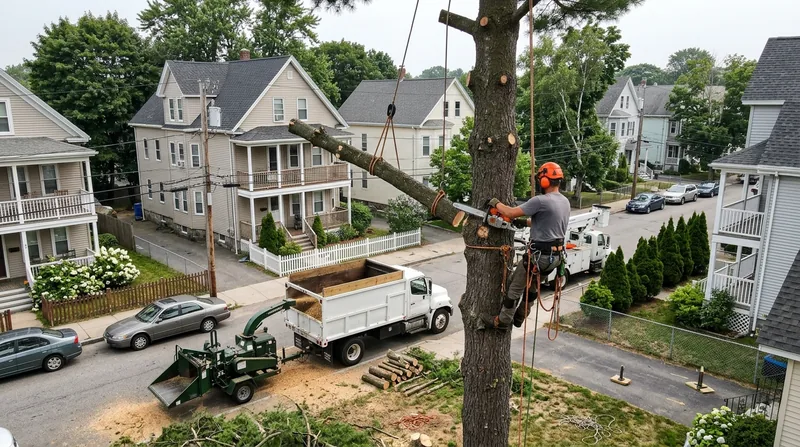




Lowell's mix of historic brick mill-era rowhouses, triple-deckers with stacked porches, and suburban colonials on wooded lots creates unique tree removal challenges. Many of these homes sit on narrow lots with overhead utility lines, tight driveways, and mature trees, often Norway maples, red oaks, eastern white pines, and declining ash, that have outgrown their space or pose safety risks. Tree removal in Lowell demands precision, local knowledge, and equipment access that standard contractors often lack. We handle hazardous, dead, and unwanted trees of any size, from dense Acre neighborhoods to the wooded hills of Belvidere and Pawtucketville, with full rigging and crane support when the job demands it. Our crew understands Lowell's terrain, building codes, permit requirements, and the species mix that defines the canopy here. Whether you're facing a storm-damaged limb over your roof or a declining ash that threatens your foundation, we remove trees safely and leave your property clean.
Why Tree Removal Matters in Lowell's Dense Neighborhoods
Lowell's compact residential layout, from downtown canal-side properties to the wooded suburbs of Chelmsford and Billerica, means trees grow close to houses, fences, utility lines, and neighbors' property lines. Dead or leaning trees become serious liabilities; mature maples and oaks can drop limbs during nor'easters or heavy snow, and declining ash trees (hit hard by emerald ash borer) fail without warning. Removing a tree before it fails saves you from emergency repair costs, insurance claims, and injury risk. Lowell also enforces local tree removal permits for trees above a certain diameter and protects heritage oaks under municipal ordinance, so knowing the rules before you cut is essential.
- We assess whether your tree is dead, diseased, or hazardous and advise on removal versus trimming.
- We obtain or verify local permits and navigate Lowell's protected tree ordinances so you stay compliant.
- We handle rigging and crane work to remove large trees safely near houses, decks, and overhead lines.
- We remove the stump and clean up debris, leaving your yard ready for replanting or other use.
- We coordinate with utility companies when power lines are at risk.
Proper tree removal protects your home, neighbors, and property value, and it's often the only safe option when a tree is beyond saving.
Key info: Lowell's municipal code requires a permit for removal of trees 6 inches in diameter or larger in some zones. Heritage oaks are protected year-round. Check with the City Assessor's office or contact us for a free permit consultation.
For more details on regulations, see the Town of Lowell official resources.
How We Remove Trees Safely in Lowell's Tight Spaces
Tree removal in dense neighborhoods like the Acre, Centralville, or Belvidere requires careful planning. We assess tree size, species, lean, proximity to structures, and access before mobilizing equipment. Some jobs call for hand-felling on open lots; others need full rigging with ropes and pulleys to lower limbs section-by-section over a house or fence. Large trees or those near power lines often need a crane to lift sections safely away from obstacles. Every removal starts with a free on-site estimate so you know exactly what we're doing and why.
- We evaluate the tree's health, lean, and proximity to utilities, structures, and property lines.
- We plan the removal method (hand-fell, rigging, or crane) based on site constraints and safety.
- We set up a work zone, protect adjacent landscaping and hardscape, and position equipment for safe access.
- We fell or rig the tree, remove all limbs and trunk sections, and haul debris to our trucks or chipper.
- We grind the stump if requested and rake the site clean so you see finished work, not a mess.
This step-by-step approach keeps your neighbors safe, your property intact, and the job on schedule.
Example: A 60-foot Norway maple in a Belvidere backyard, 15 feet from a vinyl-sided colonial and 8 feet from a chain-link fence, requires rigging and careful limb-by-limb lowering. A crane removes the trunk sections after limbs are clear. Total time: one full day. No damage to the house or fence. Stump ground on the same day.
Learn more about our emergency tree service for storm-damaged or hazardous trees that need same-day attention.
| Approach | Description | Best for |
|---|---|---|
| Hand-felling | Cutting the tree at the base and letting it fall on clear ground. | Open lots, rural sites, and small to medium trees with safe fall zones. |
| Rigging | Using ropes, pulleys, and a bucket truck to lower limbs and sections safely over obstacles. | Trees near houses, fences, utility lines, and tight urban or suburban yards. |
| Crane removal | Lifting large sections or the entire trunk away from the site with a mobile or truck-mounted crane. | Large mature trees, limited ground access, and jobs where speed and precision are critical. |
| Sectional dismantling | Climbing and cutting the tree from top to bottom in manageable sections lowered by rope. | Tall or narrow trees in very tight spaces where equipment cannot reach or operate safely. |
Tree Removal Cost in Lowell: What to Expect
Tree removal cost in Lowell depends on tree size, species, location, and access. A small ornamental or young tree in an open yard may cost $300 to $600. A mature 50-foot oak or maple near a house or power lines can run $1,500 to $3,500 or more if rigging or crane work is needed. The best way to know your actual cost is to request a free estimate. We visit your property, assess the job, and give you a firm price with no obligation. We also offer detailed pricing guidance on our site so you can plan your budget.
Several factors move the price up or down. A tree leaning toward your house or sitting between two structures costs more because we must rig it carefully and may need a crane. Dead or diseased trees (like ash or birch with pest damage) are sometimes easier to fell but harder to predict. Stump grinding adds $100 to $400 depending on size and root depth. Accessibility matters too: a narrow driveway in Pawtucketville or the Acre may require hand-carrying equipment or smaller truck access, which adds labor time. Getting 2 or 3 free estimates from insured contractors helps you compare prices and understand what each company includes (debris haul, stump grinding, site cleanup, etc.).
- Tree height, diameter, and species determine base removal cost and whether rigging or crane is needed.
- Proximity to your house, fence, utility lines, and neighbors' property affects complexity and price.
- Access constraints (narrow driveway, tight yard, no turnaround) increase labor and equipment costs.
- Stump grinding, debris removal, and site cleanup are often separate line items worth comparing across quotes.
- Emergency or same-day removal commands a premium over routine scheduled work.
Call us at (978) 848-4401 for a free, no-obligation estimate. We respond within 24 hours and walk you through the full scope and cost before any work begins.
What to Look for When Hiring a Tree Service Near Lowell
Not all tree contractors are equal. The cheapest bid often means cutting corners on safety, cleanup, or permits. When you're hiring a tree removal company near Lowell or in surrounding towns like Westford, Dracut, or Tewksbury, verify that the company is insured, and familiar with local permit rules. Ask for references from recent jobs in Lowell so you can call and ask about their experience. Understand whether your tree is protected under the municipal heritage tree ordinance (especially if it's an oak or ash). If you live in an HOA community, check whether removal of a visible tree requires board approval before you contract.
- Confirm the contractor carries general liability and workers' compensation insurance.
- Ask for references from three recent jobs in Lowell or nearby cities and call to verify their experience and cleanup standards.
- Request a written estimate that itemizes tree removal, stump grinding, debris haul, and site cleanup so you know what you're paying for.
- Check whether the tree is protected by Lowell's heritage ordinance or if a municipal permit is required before cutting.
- Review your HOA bylaws or deed restrictions if applicable, and confirm removal won't trigger fines or require approval.
- Compare at least two estimates and be wary of prices far below or above the market range; unrealistic bids often signal hidden costs or poor quality.
We encourage you to get multiple quotes and ask the tough questions. When you're ready to move forward, contact us for a free estimate and we'll show you exactly what we do and why.
Tree Removal in Lowell: Pricing Guide
| Service | Price | Details |
|---|---|---|
| Small tree removal | $300-$600 | Trees up to 30 feet, open yard access, hand-felling or simple bucket truck work, no stump grinding |
| Medium tree removal | $800-$1,800 | 30 to 50 feet tall, rigging over house or fence, moderate access constraints, stump grinding optional |
| Large or complex removal | $2,000-$5,000+ | 50+ feet, crane work, multiple trees, near power lines, tight urban lot, or emergency response premium included |
| Stump grinding | $100-$400 | Grinding depth and root system size drive cost; small stumps under 12 inches are quick, large oaks or maples take longer |
| Free estimate | No charge | 24-hour response, on-site assessment, written quote, no obligation to book, includes permit guidance |
Indicative pricing, the exact cost depends on square footage, finish, and site access. Free personalized estimate within 24h at (978) 848-4401.


